- Shopping, made easy.
- /
- Get the app!
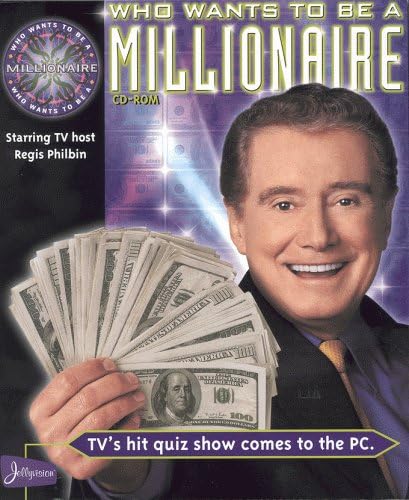
Faster than you can say "cha-ching," Disney has released Who Wants to Be a Millionaire: a terrific realization of the wildly successful television game show. Boasting voice work by Regis Philbin himself and a game engine by the makers of the well-respected You Don't Know Jack series, this is the perfect family title.
We originally reviewed the title for about an hour and a half before surmising its rating. By all means a good title, there's one big problem that arises only after repeated hours of play: the questions repeat, and repeat ... and repeat. Frankly, the resurfacing of questions--there are only about 200 total--was the only way we made it to a million dollars, but we can see that not everyone sees this as an enjoyable "asset." The justification from the manufacturer is that the package is at a low price and was never meant for hard-core gamers (or people who install the game on multiple machines). But even for just twenty dollars, you'll wind up being really sure how many stock make up the Dow 500 after five to ten hours of game play, and may walk away annoyed. People looking to purchase this game for multiplayer action also won't be pleased, since players who have spent time with the game will be at an advantage to climb to higher dollar amounts.
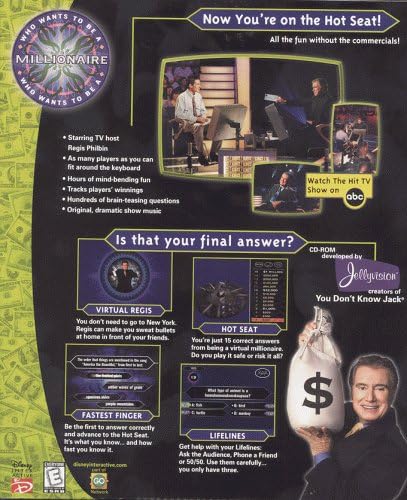
The best elements of the real-life game show through: in particular, Regis and his friendly-yet-sarcastic commentary. The software even mimics the pauses Regis takes, building tension as the (virtual) dollars mount up. "You think it's D?" he asks. With more inflection, and as if you're nuts, he adds: "That's your answer?" Then he bellows: "You are correct!" With touches like these, players really do feel like they're in the hot seat. (Regis even makes fun of you when you flunk out, exhorting you not to spend your zero-dollar check in one place.)
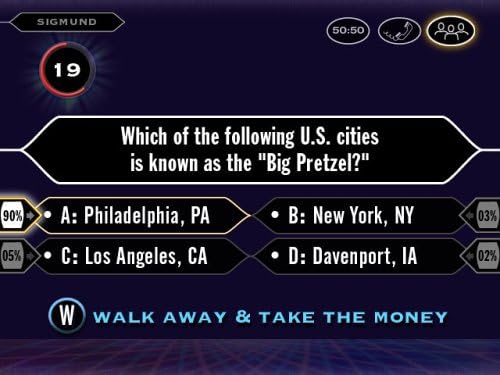
The game begins with the same painfully simple hundred-dollar-increment questions, revolving around pop-culture topics like Pac Man, the Jeffersons, and "Who's known as the 'Chairman of the Board'?" Just like the show, the easy questions soon dissipate into the more challenging, with topics revolving around things like the United Nations Security Council. The same lifelines are also in place, but instead of calling on your own support person--who's most likely standing behind your shoulder, ready to play the next round--you're saddled with Regis's own friends. (He seems to travel in a pretty uneducated crowd, since they provided wrong answers much of the time, tripping us up.)
Another warning: this isn't really a multiplayer game in the true sense of the word. All the parties try to buzz in on one question, ranking certain choices, for example, in numeric order. Whoever is quickest with the right answer wins the chance to see the questions through to the full million. That translates to a lot of time spent watching someone else play, but with this game, it's somehow excusable.
With great, simple graphics influenced by the show and the same violin-and-heartbeat soundtrack, Millionaire deserves to be a runaway success. The creators worked quickly but well, creating a game that everyone can enjoy, provided you can accept its considerable glitches. For fans of the TV game, time spent with this game will have you smiling as broadly as million-dollar-winner John Carpenter--without all the tax headaches in the morning. --Jennifer Buckendorff
TV's hit quiz show comes to the PC. Now you're in the hot seat with host Regis Philbin. You're just 15 correct answers away from becoming a virtual millionaire. The pressure is on. Win a million--or lose it all. Just try not to sweat when Regis asks, "Is that your final answer?"
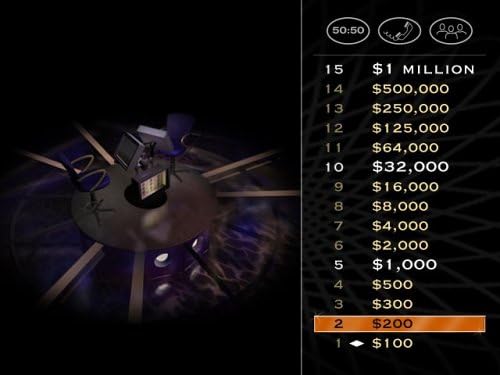
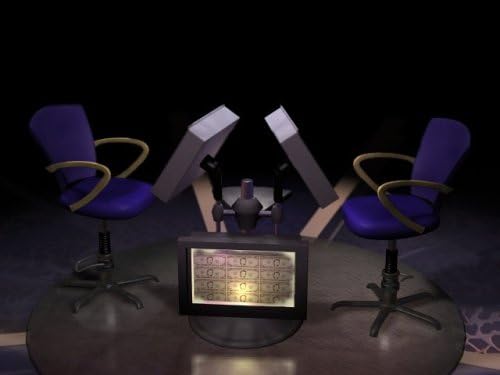
Most hard-core gamers probably gnash their teeth at the thought of Regis Philbin and his simple-minded trivia game outselling every other supposedly respectable game on the market. The TV game show that has every executive from other networks feverishly reshuffling his prime-time grid is also burning up the computer entertainment charts. With more than a million copies sold and no end in sight, Who Wants to Be a Millionaire is the people's choice, whether fraggers like it or not. Much like the TV show, and perhaps like Regis Philbin himself, Millionaire the computer game appreciates its own mediocrity, but it executes its blandness extremely well. First of all, the price is low enough ($19.95) to make it an ideal impulse buy. Second, it's got Regis himself, who's key to the game show's success. After all, Millionaire is about achieving unearned success by showing mastery of trivial knowledge that otherwise gets people nowhere in life. Who better to usher these average Americans into the Hot Seat and give them a shot at accidental wealth than a common-man celebrity like Regis? While the game doesn't reproduce the social drama that makes the TV show so popular, it makes do with the bare-bones gameplay and adds some of the design qualities of the developer's signature product, the much better You Don't Know Jack. Each aspect of the show is re-created in the computer game in some fashion. In single-player mode, you go right into the Hot Seat, where you must ascend a ladder of 15 multiple-choice trivia questions to win. Reaching the one thousand and thirty-two thousand dollar milestones guarantees you will win at least that much if you lose later, though it hardly matters. All you'll get is an onscreen check with Regis' signature. When you feel stumped, you have three "lifelines" to use throughout the climb. The 50/50 option removes two of the three wrong answers to a question. You can ask to poll the audience, which gives you the actual results taken from a sample group for each question. The most impressive re-creation is the phone-a-friend lifeline, in which Regis calls one of his friends, who then struggles to offer a suggestion that may or may not be right. Jellyvision and Disney evidently invested the necessary resources to give the game as much of the TV feel as possible. While Regis doesn't actually read off all of the questions, he does offer the color commentary about where you are on the ladder and banters with the phone-a-friend character. Even after many hours of play, there still wasn't any tedious redundancy in his comments, and the question database seemed sufficiently deep to avoid frequent repeats. With years of You Don't Know Jack experience under their belts, the Jellyvision designers know how important a smooth audio-visual experience is to keeping a simple game interesting. In addition to the melodramatic music, the questions - which pop in and out, causing the screen to rearrange itself - are animated well. Regis comments on the game without any telltale sound splices or lag times for disk access. However, the questions are noticeably more media and pop-culture-related than those in the TV version, suggesting that Jellyvision may have been dipping into the You Don't Know Jack database. Unfortunately, the Fastest Finger multiplayer qualifying round is the weakest part of the game. On TV, more than a dozen contestants must arrange four items (like movies or historical events) into the correct order, usually chronological. Getting the fastest correct answer sends you to the Hot Seat. The computer variant struggles to re-create this by letting any number of people choose a letter as their own on the PC keyboard. The computer then shuffles the four items into different orders. The first person to press a key when the right order comes up wins, and then the standard single-player mode starts. Who Wants to Be a Millionaire could have been a better game in other ways as well. It's hard to say whether a network-play variant could have worked better than the Fastest Finger option, which just doesn't make Millionaire into the party game that You Don't Know Jack is. A head-to-head or multiplayer contest in which players simply respond to the same multiple-choice questions simultaneously until one player remains would have probably worked better. And since the central drama of Millionaire has to do with the money at stake, it would have been interesting to link the home and on-air versions somehow. For instance, home players who consistently reach the top of the money ladder could automatically apply to be TV contestants. But for $19.95, one probably shouldn't complain that Jellyvision didn't explore any extensions to the basic gameplay. As it stands, Who Wants to be a Millionaire is both a faithful and entertaining simulation of the TV show. You Don't Know Jack is far and away the better trivia game, as it's both more entertaining and more appropriate for party play. But it's definitely the game for those who want to see how well they would do in the infamous Hot Seat. It may also be the best way to permanently shut up that irritating, know-it-all family member who barks out the answers to all of the questions whenever the show is on TV. --Steve Smith
--Copyright ©1998 GameSpot Inc. All rights reserved. Reproduction in whole or in part in any form or medium without express written permission of GameSpot is prohibited. -- GameSpot Review
 Epic Mickey: Power of Illusion
SAR 42
Epic Mickey: Power of Illusion
SAR 42
 Disney Sing It: Pop Hits - PlayStation 2
SAR 53
Disney Sing It: Pop Hits - PlayStation 2
SAR 53
 -32%
Camp Rock Final Jam - Nintendo DS
SAR 71
-32%
Camp Rock Final Jam - Nintendo DS
SAR 71
 Disney Wizards of Waverly Place: Spellbound - Nintendo DS
SAR 105
Disney Wizards of Waverly Place: Spellbound - Nintendo DS
SAR 105

 Saudi Arabia