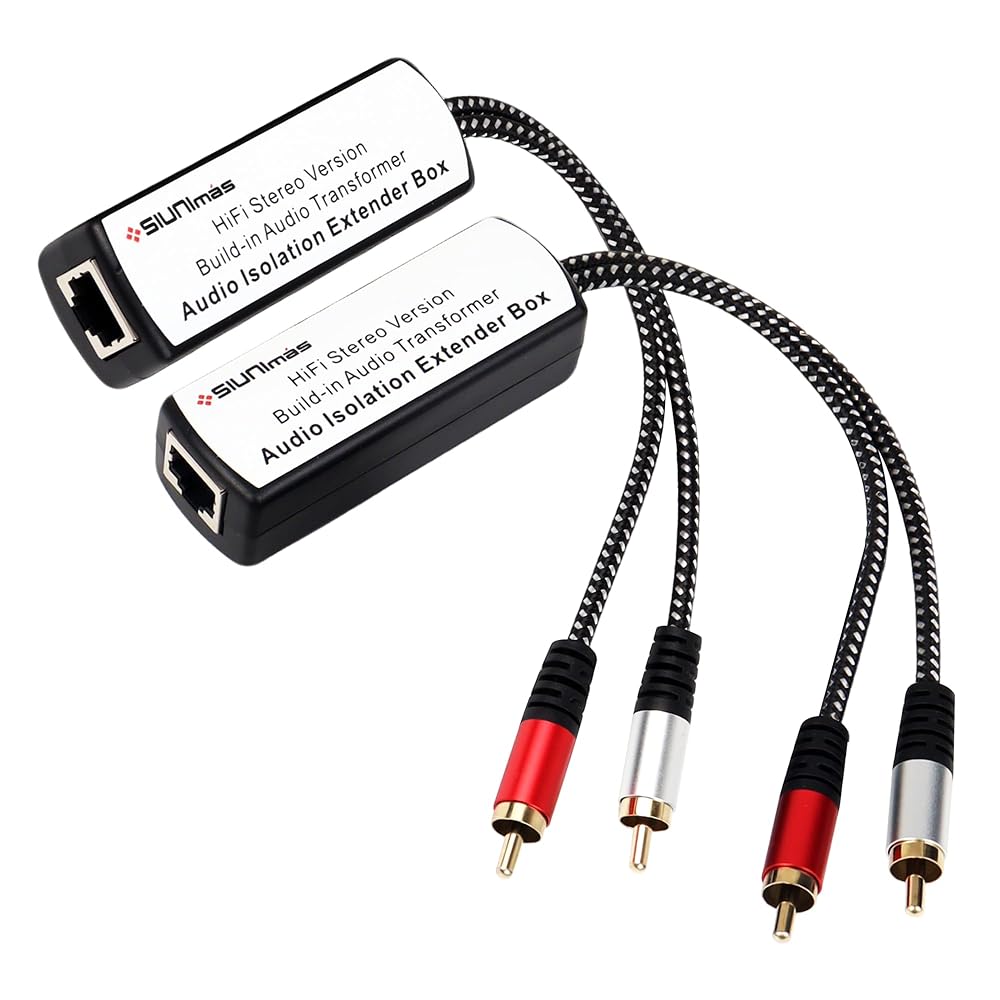
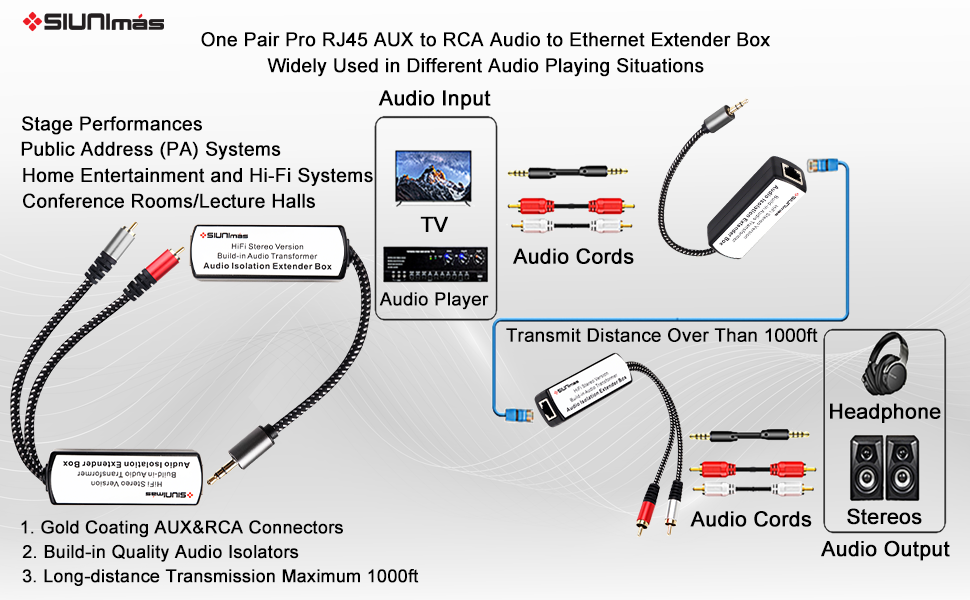
Audio Signal Extension Transmission--It utilizes standard network cables (RJ45) for audio signal transmission. This approach is often more cost-effective and can overcome the distance limitations of traditional audio cables, reducing signal degradation and inherent noise over long runs.
Eliminates Hum and Ground Loop Noise--The devices well build-in audio isolators. When connecting different devices, ground potential differences can create "ground loop noise" (e.g., a low-frequency 50/60Hz hum). The device effectively breaks the ground loop by isolating the ground connections between input and output signals, completely eliminating this type of interference and restoring clean audio.
Protects Audio Equipment--It isolates potential differences between connected devices, preventing issues caused by such differences, like current backflow. This is especially important during accidental plug insertions/removals, as it helps prevent arcing and protects the interface chips of both source and receiving devices.
Plug-and-Play, No Drivers Needed--Features a passive, requiring no driver installation. Automatically recognized upon connection, it simplifies the deployment process, making it ideal for quick setup in live performances, engineering installations, and conferencing systems.
Anti-Interference & High Fidelity--Built-in audio transformers modules effectively suppress ground loop noise, ensuring pure audio transmission with low noise levels.
Application Scenarios:
(A)Stage Performances: Transmit mixer audio over long distances to stage monitor speakers, avoiding signal loss and crosstalk from long cable runs.
(B)Conference Rooms / Lecture Halls: Connect computers or media players to remote speakers. Enables clean cabling and supports multi-room audio distribution.
(C)Public Address (PA) Systems: Transmit audio from cameras or broadcast announcements via Ethernet cables to control rooms or remote monitoring points.
(D)Home Entertainment and Hi-Fi Systems: Audiophiles often use it as a tool to enhance sound quality. Placed between the audio source and amplifier, it filters out artifacts and background noise, resulting in fuller, more dynamic, and cleaner audio.
 4-in 1-Out RCA and 3.5mm Aux Audio Switching Box 4 Channels Audio Converter Passive Audio Selector Switch Box 1-in 4-Out (S401-RCA AUX)
SAR 133
4-in 1-Out RCA and 3.5mm Aux Audio Switching Box 4 Channels Audio Converter Passive Audio Selector Switch Box 1-in 4-Out (S401-RCA AUX)
SAR 133
 Pro XLR 3Pin 3Channels XLR Selector Box XLR Balanced Switching Box 3-in 1-Out/1-In 3-Out Interchangeable HiFi Stereo Passive Audio Selector Swtich Box(MS-XLR-0301)
SAR 188
Pro XLR 3Pin 3Channels XLR Selector Box XLR Balanced Switching Box 3-in 1-Out/1-In 3-Out Interchangeable HiFi Stereo Passive Audio Selector Swtich Box(MS-XLR-0301)
SAR 188
 Pro GLI-XTS-02 3Pin XLR/TS/TRS 6.5inch Ground Loop Noise Isolator Box Hum Eliminator for Audio Playing System Ground Loop Isolation (Pro GLI-XTS-02)
SAR 376
Pro GLI-XTS-02 3Pin XLR/TS/TRS 6.5inch Ground Loop Noise Isolator Box Hum Eliminator for Audio Playing System Ground Loop Isolation (Pro GLI-XTS-02)
SAR 376
 -14%
PROZOR 192KHz Digital to Analog Audio Converter Support 5.1CH Optical to RCA Converter with Magnetic Ring Power Cord + 5V 1A Power Supply Adapter
SAR 162
-14%
PROZOR 192KHz Digital to Analog Audio Converter Support 5.1CH Optical to RCA Converter with Magnetic Ring Power Cord + 5V 1A Power Supply Adapter
SAR 162

 Saudi Arabia