- التسوق ، اصبح سهلا.
- /
- احصل على التطبيق!
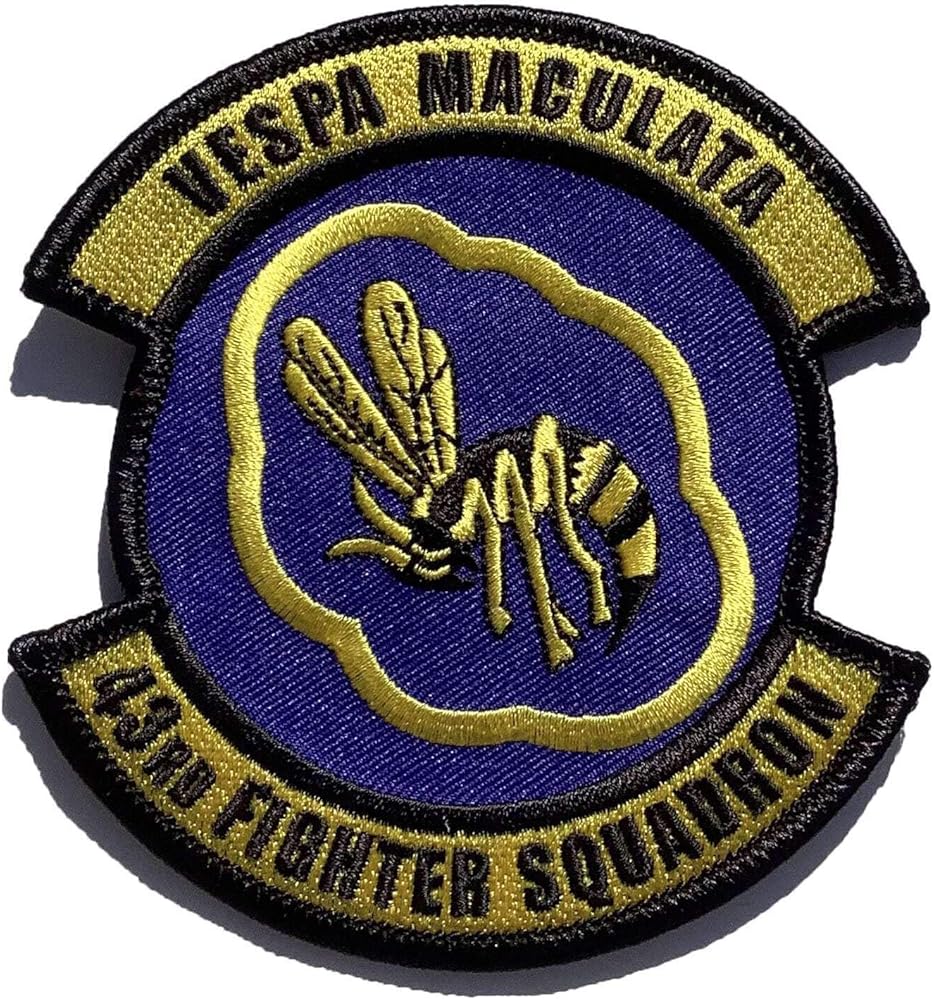
4 inch 43rd Fighter Squadron Vespa Maculata Patch - Sew On
The 43d Fighter Squadron is part of the 325th Fighter Wing at Tyndall Air Force Base, Florida. It conducts advanced fighter training for F-22 Raptor pilots.
The squadron is one of the oldest in the United States Air Force, its origins dating to 13 June 1917, when it was organized at Kelly Field, Texas as the 43d Aero Squadron. The squadron deployed to England as part of the American Expeditionary Force during World War I. The squadron saw combat during World War II, served in the Vietnam War and later became part of the Alaskan Air Command (AAC) during the Cold War.
World War I
The 43d Fighter Squadron traces its lineage to the 43d Aero Squadron, first activated 13 June 1917, at Camp Kelly, Texas. In March 1918, the squadron moved to England, where it trained until reassigned to France where it landed on 25 October, reaching on the same day the Air Service Replacement Concentration Barracks at St. Maixent. Ordered to 3rd Aviation Instruction Center, the squadron arrived at the Issoudun Aerodrome on 1 November. The Armistice signed on 11 November made it redundant, and it stayed at Issoudun until early 1919, when it moved to the harbor of Bordeaux, France, leaving France on 18 March, bound for the United States[3][2]
Inter-war years
The 43d was reactivated on 22 July 1922, at Kelly Field, Texas, and was redesignated the 43d School Squadron in January 1923. The squadron flew various aircraft, including the DH-4, Spad XIII, SE-5, MB-7, AT-4, AT-5, PW-9, P-1, and P-12. The 43d became known as the "Hornets" as depicted by their emblem, a poised Vespa Maculata, or American "Yellow Jacket," the most formidable of the wasp family, surrounded by an ovate cloud. The emblem was approved in 1924 and the Hornet signifies the speed, agility and hard-hitting capabilities of the squadron while the cloud represents their domain - the skies.[2] In March 1935, the 43d was redesignated the