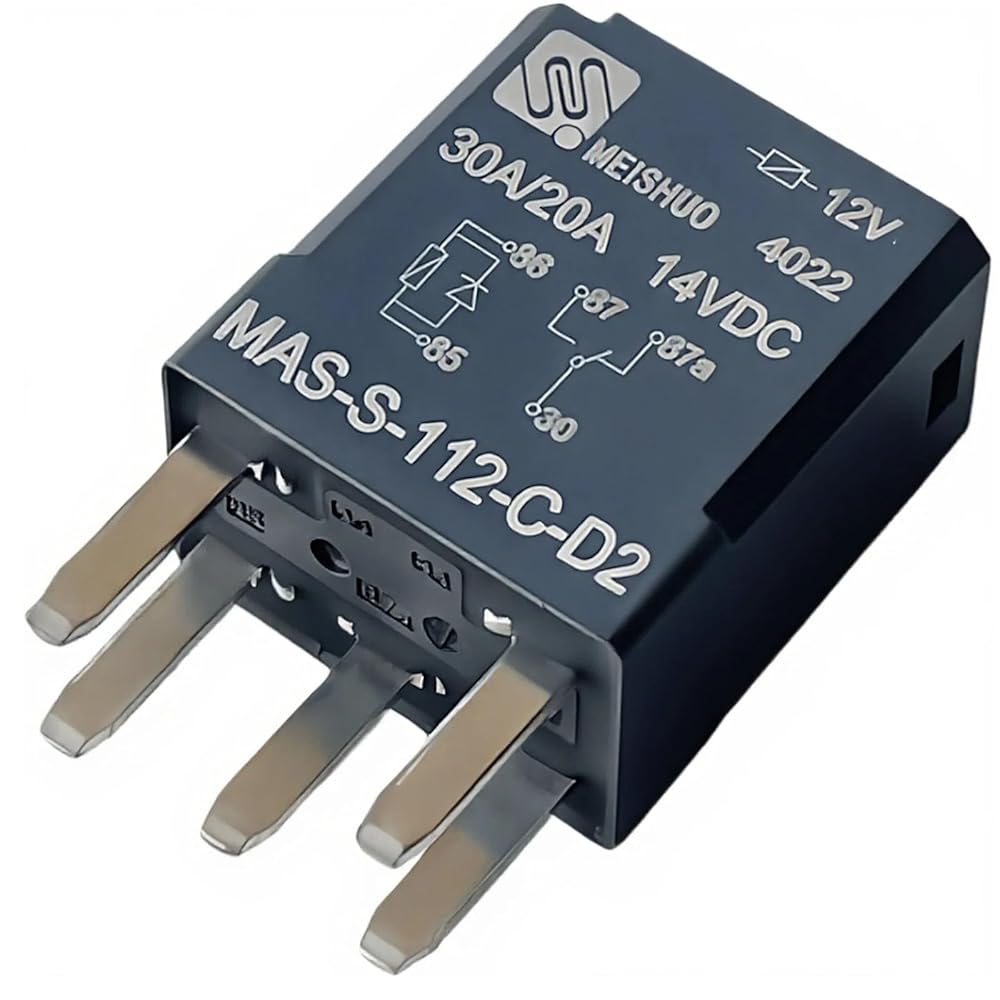
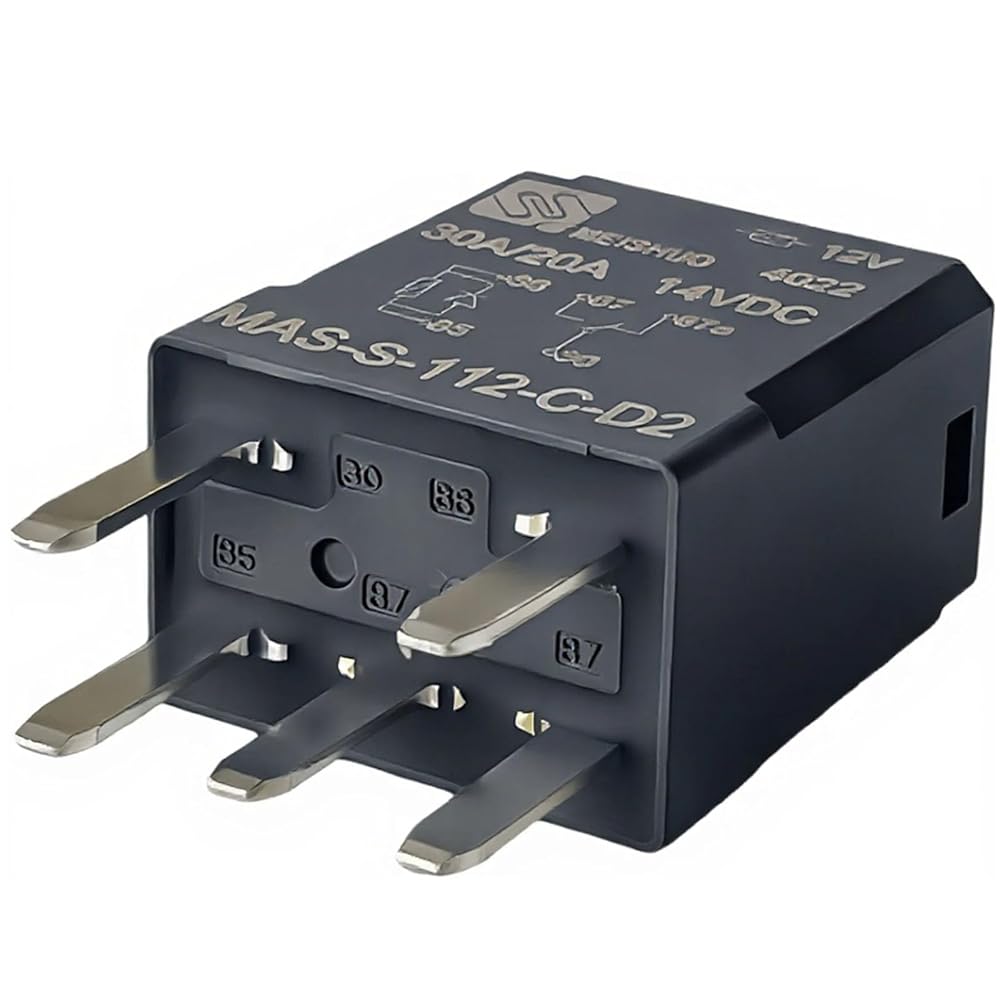
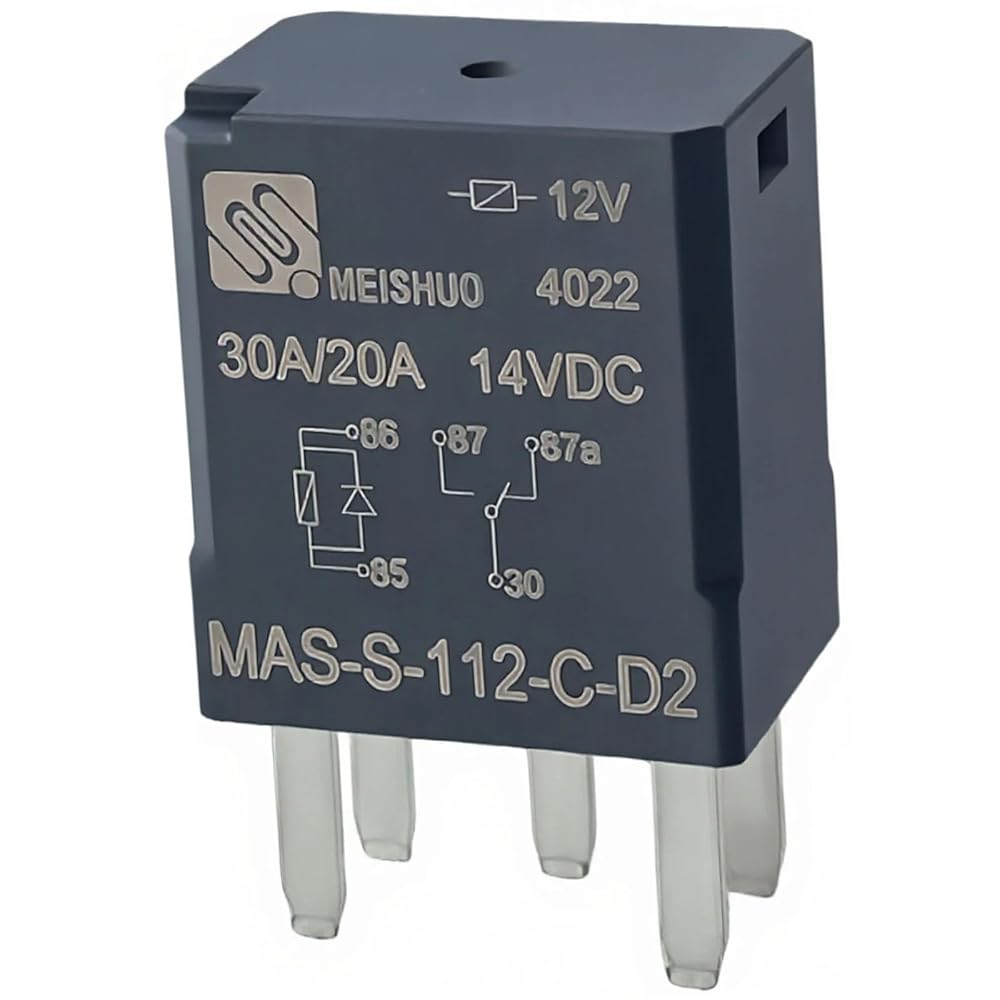
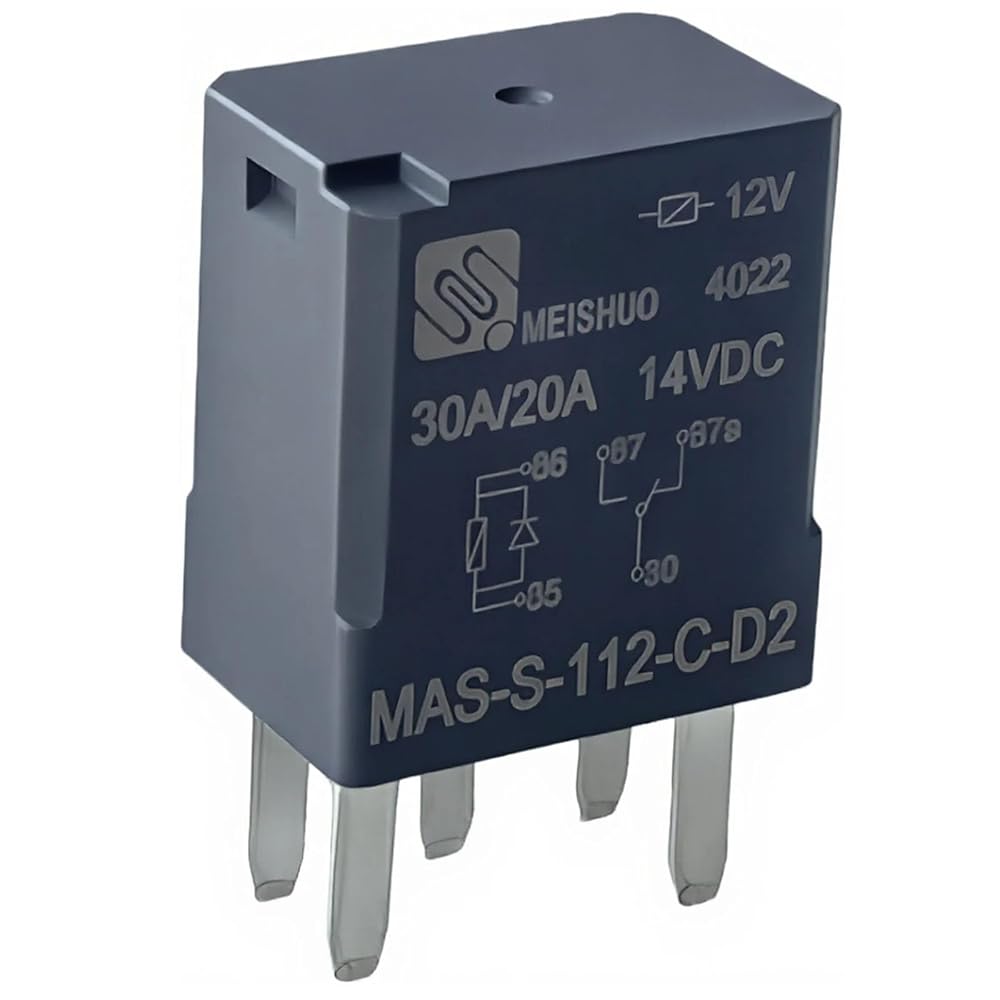
Specs & cross-reference style: 12V coil (≈109Ω, ≈1.3W), SPDT/Form C (85/86 coil, 30 common, 87 NO, 87a NC), NO/NC continuous 30A/20A @14V, max switching voltage 28VDC, sealed body, operating −40–125°C; built-in flyback diode D2 across the coil (anode on 85). Compatible with ISO 280 micro changeover relays that share these specifications and diode orientation; Compatible with MAS-S-112-C-D2 type units in the same footprint when pinout matches.
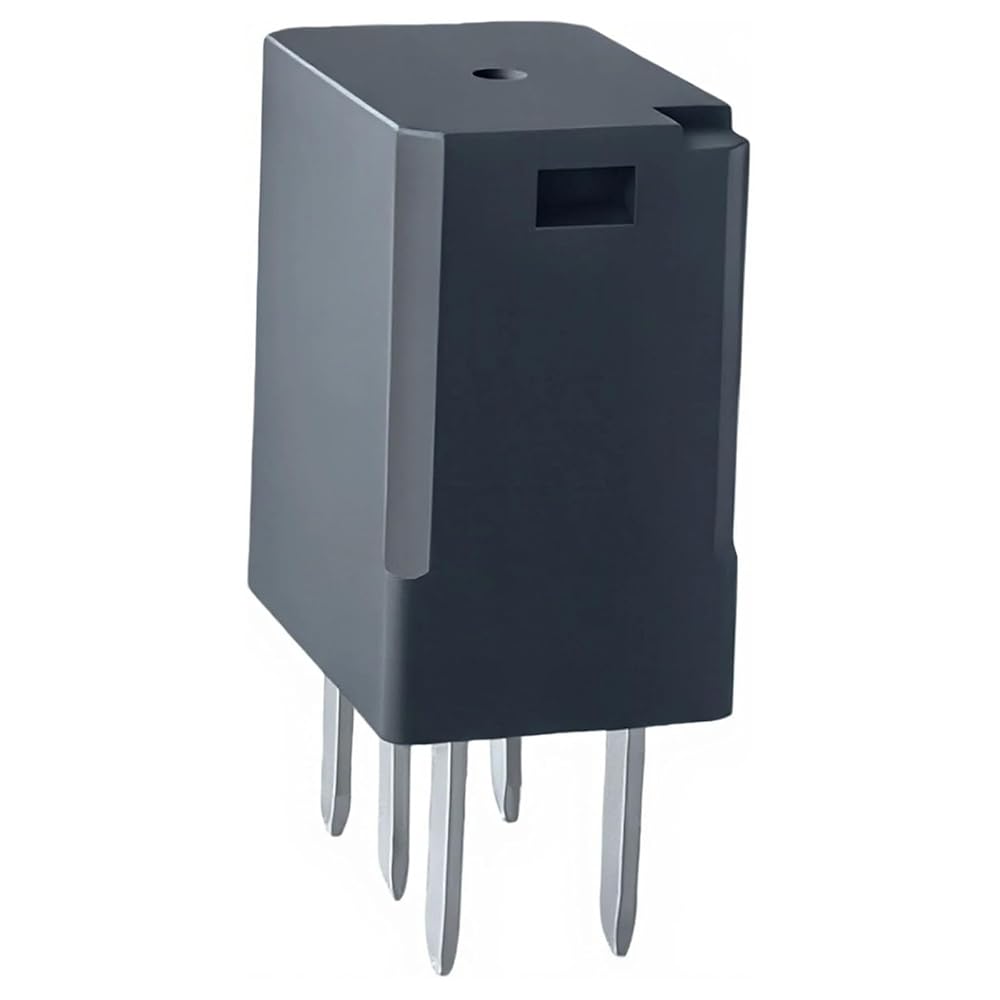
Operation & install location: Plug-in micro relay for engine-bay or interior fuse/relay boxes using ISO 280 sockets. Typical control points include A/C compressor clutch, cooling/radiator fan, fuel pump, blower motor, lighting/lamps, and flasher circuits. Helps resolve no-engage A/C, fan not running, no-prime fuel pump, intermittent power due to worn/stuck contacts. Verify socket labeling and diode orientation (D2 = anode on 85) before installation; body approx. 22.5×15×25 mm.
Compatibility guidance: Compatible with 12V passenger cars, SUVs, pickups, UTV/ATV, marine/RV and equipment that use an ISO 280 micro 5-pin SPDT relay with D2 diode orientation and standard 85-86/30-87-87a pinout. Use when your OE relay or fuse-box legend indicates “micro/ISO 280, SPDT/Changeover, 12V, diode, 30/87/87a, 85/86”. Not for 24V systems or “resistor-suppressed” variants; check coil symbol printed on the OE relay or service manual.
Complementary items & how they pair: Works with ISO 280 micro relay sockets, add-a-relay harnesses and fuse holders for clean repairs or accessory additions (fan/AUX lighting/A-C clutch circuits). For preventive maintenance, pair with spare micro relays for critical circuits (cooling fan/fuel pump) to reduce downtime; use contact-rated wiring and properly sized fuses per circuit current to protect loads and avoid overheated terminals.
Durability & testing: Designed for automotive environments; electrical endurance up to 100k operations under rated load profiles (resistive/flasher/lamp). Vibration and shock tested; insulation and dielectric strength per spec. Sealed construction helps resist moisture/dust in under-hood fuse boxes when the correct cover is used. Always de-energize the circuit before replacement and confirm seating/retention in the socket.
 Genuine OEM G4R-H24 Type 12V JASO Plug-in SPST Relay, 25A (120A Inrush), Compatible with JASO 1a Sockets for Headlamp, Blower, Defogger, Horn & A/C Clutch Circuits
SAR 89
Genuine OEM G4R-H24 Type 12V JASO Plug-in SPST Relay, 25A (120A Inrush), Compatible with JASO 1a Sockets for Headlamp, Blower, Defogger, Horn & A/C Clutch Circuits
SAR 89
 53ND12-Y-HW 12V 40A PCB Power Relay, 6-Pin DIP SPST-NO, 40125C, AgSnO2 - Compatible with FBR53-HW Footprint for 12V Automotive Modules
SAR 53
53ND12-Y-HW 12V 40A PCB Power Relay, 6-Pin DIP SPST-NO, 40125C, AgSnO2 - Compatible with FBR53-HW Footprint for 12V Automotive Modules
SAR 53
 0025428819 Multi-Purpose Relay, 12V 4-Pin NO—Replaces A0025428819 / 002-542-88-19; Compatible with Mercedes-Benz (W205 C-Class, W213 E-Class, W222 S-Class, X253 GLC, W156 GLA, W246 B-Class)
SAR 47
0025428819 Multi-Purpose Relay, 12V 4-Pin NO—Replaces A0025428819 / 002-542-88-19; Compatible with Mercedes-Benz (W205 C-Class, W213 E-Class, W222 S-Class, X253 GLC, W156 GLA, W246 B-Class)
SAR 47
 25230-79915 12V Automotive Relay – Compatible with Nissan Altima 2004-2006, Nissan Maxima 2000-2006, Nissan 350Z 2003-2005; Compatible with Infiniti G35 2003-2006 – Replaces 25230-79917
SAR 47
25230-79915 12V Automotive Relay – Compatible with Nissan Altima 2004-2006, Nissan Maxima 2000-2006, Nissan 350Z 2003-2005; Compatible with Infiniti G35 2003-2006 – Replaces 25230-79917
SAR 47