- Shopping, made easy.
- /
- Get the app!
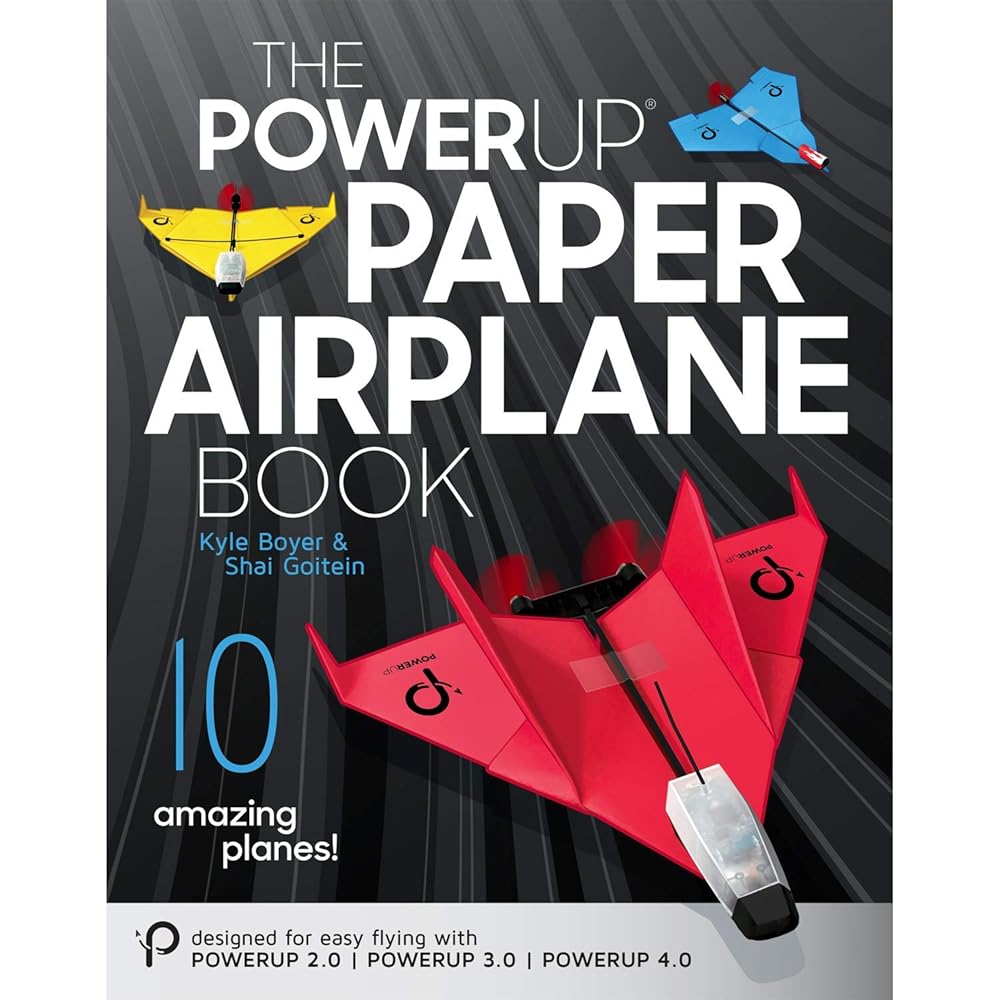
POWERUP TOYS THE POWERUP PAPER AIRPLANE BOOK
Writing The POWERUP Paper Airplane Book has been a uniquely personal and rewarding experience. For more than a decade, I have been immersed in the world of powered and remote-controlled paper airplanes—first as an inventor, then as a product designer, and eventually as the founder of POWERUP Toys. Over the years, I have met thousands of creators, tinkerers, STEM educators, children, and lifelong hobbyists who all share the same spark: the thrill of transforming a simple sheet of paper into something that flies. This book grew out of that journey.
I co-authored this book together with Kyle Boyer, the creator of Foldable Flight. Kyle is one of the most respected paper-aircraft designers working today, and collaborating with him allowed us to bring together two complementary perspectives: the artistic craft of high-performance paper-airplane design, and the engineering discipline behind powered flight. Combining these two worlds is what makes this book different from typical paper-airplane collections. Our goal was not only to give readers ten beautiful and exciting airplanes to build, but also to reveal the deeper process behind designing, testing, refining, and ultimately flying powered paper aircraft successfully.
The book is unique in that it also tells the development story behind the scenes, how the idea of powering a paper plane came about, how early prototypes worked (and often didn't work), and how the technology evolved into today's POWERUP modules. Many books focus only on how to fold airplanes; very few explore what it takes to make paper planes compatible with thrust, propulsion, electronic stabilization, and remote control. In this book, I wanted to share that journey as honestly and clearly as possible: the failures, the breakthroughs, the small discoveries that only appear in the workshop late at night, and the surprising physics lessons that emerge when you push a sheet of paper beyond what anyone assumed it could do.
Readers will find an entire chapter devoted to the invention process, how concepts were sketched, how the first powered prototypes behaved, and how incremental innovations led to more stable, more agile, and more resilient designs. The story behind POWERUP is an engineering story, but also a human one. It shows that innovation often begins with curiosity, a willingness to experiment, and the persistence to test ideas dozens or even hundreds of times before they work. Sharing this side of the project felt essential, because it provides context for the airplanes in this book: each one is not just a fold, but part of a larger engineering lineage.
Alongside the narrative and design journey, we included a full technical section dedicated specifically to the theory of powered and controlled paper airplanes. Many principles that apply to traditional model aircraft or full-scale aviation do not transfer cleanly to ultralight, flexible paper structures driven by micro-propulsion. Paper behaves in its own way, it flexes, it warps, it twists under load, and it reacts dramatically to small trim changes or thrust angles. When you attach a motor and propeller, everything becomes more nuanced. The book explains how factors like thrust line, torque, center of gravity, airspeed, structural stiffness, and stabilizer geometry interact in this unique domain. This theory section was written to be approachable for beginners but deep enough to be valuable for teachers, hobbyists, and students who want to treat this as a true STEM discipline.
Of course, at the heart of the book are the ten airplanes themselves. They represent some of the most effective and exciting designs created specifically for use with POWERUP 2.0 and POWERUP 4.0 modules. Each airplane was tested extensively to ensure it behaves predictably under power and that it brings out the best performance possible from the propulsion system. Kyle and I worked closely to make sure every design is clear to follow, visually elegant, and structurally optimized for powered flight. These are not simply paper airplanes with a motor added; they were conceived from the first sketch with thrust, lift, and control in mind.
To help readers succeed, each aircraft includes detailed folding instructions, trimming diagrams, and "hot tips" that highlight the small adjustments that often make the difference between a short hop and a long, steady flight. Over the years of teaching workshops and observing how people build and fly POWERUP planes, I have learned that success comes from understanding the basics: how to align surfaces, how to balance the plane properly, how to adjust the wings, and how to respond when the airplane does something unexpected. All of these insights are collected throughout the book in a practical, hands-on way.
We also devoted a full chapter to preparing for flight. This chapter includes guidance on selecting paper, maintaining the modules, tuning surfaces, checking angles, adjusting the center of gravity, and choosing the right environment for testing. Powered paper airplanes are remarkably capable, but they are also sensitive to setup. With the right preparation, anyone, children, parents, educators, or hobby pilots can achieve consistent, satisfying flights. Without preparation, even a great design may struggle. For that reason, we wanted this book to be not just inspirational but also instructional.
Troubleshooting is another crucial part of the powered-paper-plane experience, and we approached it directly. The troubleshooting chapter helps readers diagnose and fix common issues such as stalling, diving, veering, torque roll, uneven lift, or insufficient thrust. Instead of presenting generic advice, we focused on the specific problems that arise when combining lightweight paper geometry with the POWERUP module's thrust and control characteristics. This guidance is based on thousands of test flights and many years of teaching users how to refine their builds.
I see this book as part of a larger story. Over the years, POWERUP has evolved from a simple idea "What if we could motorize a paper airplane?" into a platform for creativity, education, and experimentation. Around the world, classrooms use POWERUP kits to teach physics and engineering. Families fly them in backyards and parks. Enthusiasts build custom wings and unique designs. And many readers who encounter this book may discover for the first time how accessible and exciting aeronautics can be when it begins with an ordinary sheet of paper.
Working with Kyle Boyer was one of the most enjoyable parts of bringing this project to life. His approach to paper engineering, precise, artistic, and deeply thoughtful perfectly complements the powered flight expertise that I bring from years of product development. Together we wanted to create something more than a collection of diagrams. We wanted a book that readers could return to again and again, each time finding another insight that improves their understanding and their flights.
I hope readers feel the care that went into every page. Whether you are new to the hobby or already deeply involved in flight and design, my goal is that this book gives you tools, stories, and inspiration to explore further. Powered paper airplanes may appear simple, but they open the door to real aerodynamics, real problem-solving, and the kind of imaginative thinking that makes engineering so rewarding.
Thank you for taking the time to explore this book. I hope your building and flying experience is as fun and enlightening as the journey that led to creating it.
Shai Goitein
TIME TO FLY
The PowerUp Paper Airplane Book contains step-by-step instructions
and links to video tutorials for 10 exceptional paper airplanes,
specifically designed to work well with the POWERUP 2.0, 3.0, and
4.0 modules or on their own. From classics such as the Nakamura
Lock to novel creations from the renowned paper airplane designer
Kyle Boyer, these truly are some of the best planes ever made! The
book also includes an introduction to aerodynamics, tips and tricks for
flying with the PowerUp modules, and an account from Shai Goitein,
the inventor who brought smartphone-controlled paper airplanes into
the world! Whether you're a beginner or expert pilot, an origami
novice or an avid folder, a STEM teacher, or the cool dad looking for
a fun family activity, this is the paper airplane book for you!
Shai Goitein is an inventor, entrepreneur, and lifelong aviation enthusiast.
He is the founder and CEO of PowerUp Toys, a company dedicated to transforming simple paper airplanes into smart, educational flying experiences enjoyed around the world. For more than a decade, Shai has blended engineering, design, and storytelling to inspire creativity in children and adults alike.
His work has appeared in classrooms, maker communities, and international toy fairs, where his innovations continue to spark curiosity about flight, physics, and hands-on learning.

 Saudi Arabia