- Shopping, made easy.
- /
- Get the app!
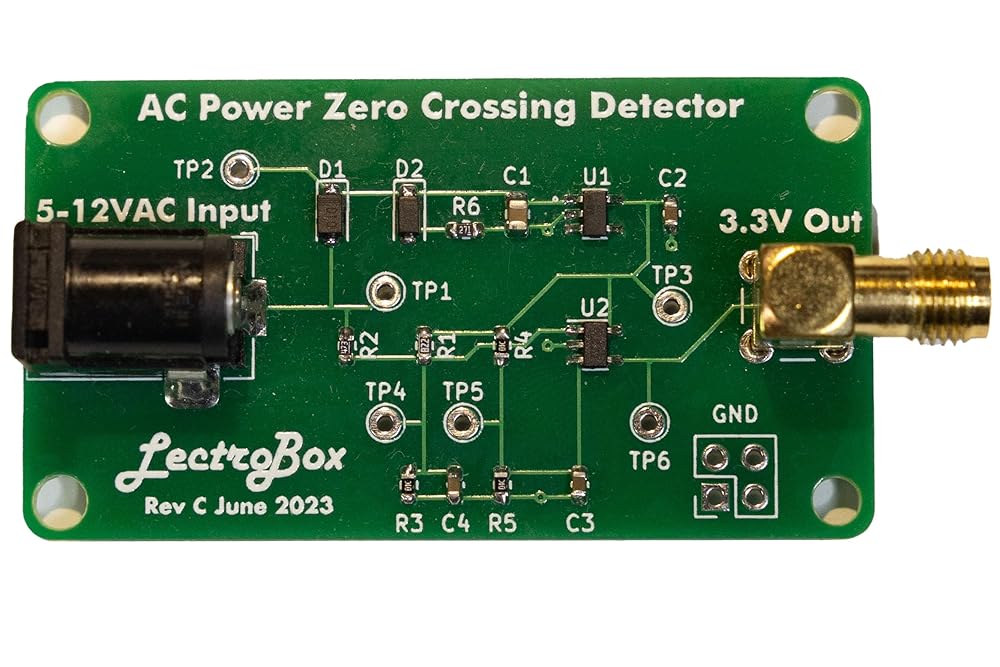
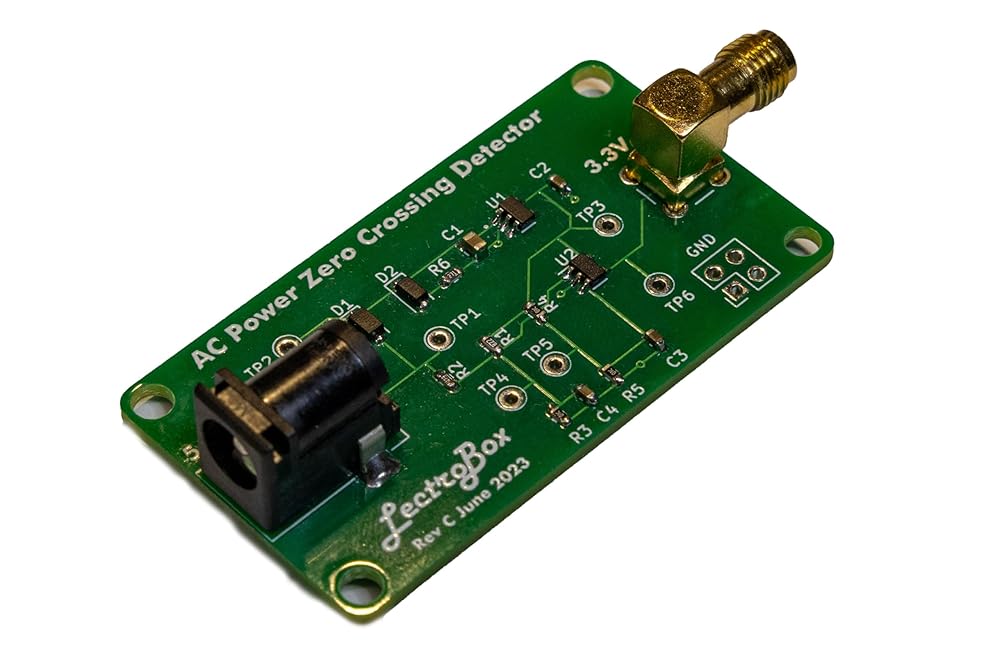
This electronic test device takes 12 volts AC as input, and emits a 3.3 volt unipolar square wave that indicates the polarity of the output. This zero-crossing detector has a variety of uses; it was originally designed to serve as part of a system to measure the phase and frequency of electrical power grids. The input is used both to power the device and provide the signal under test. Input is provided on a 5.5mm barrel jack, typical for AC power adapters ("wall warts"). The output is either 3.3V or 0V depending on the polarity of the input. The output is provided on an SMA jack, making it easy to feed into interval counters or other lab equipment. The zero-crossing detector ships with a simple RC filter on the input which rolls off at 100Hz. This is useful for glitch resistance when measuring grid power and delays the response time to polarity changes by 500us. For applications that require faster response time, the filter can be disabled through the removal of one capacitor. More information and sample data can be found at lectrobox.com/zcd
 MESR-100 Capacitor Tester V2, Geevorks Professional Capacitor Tester, Ohm Meter 0.001-100.0R with SMD Test Clip, Auto-Ranging Capacitor for Measuring Capacitance Resistance Circuit
SAR 406
MESR-100 Capacitor Tester V2, Geevorks Professional Capacitor Tester, Ohm Meter 0.001-100.0R with SMD Test Clip, Auto-Ranging Capacitor for Measuring Capacitance Resistance Circuit
SAR 406
 Fluke L210 Probe Light and Extender Kit
SAR 440
Fluke L210 Probe Light and Extender Kit
SAR 440
 DC Current Clamp Meter 6000 Counts Auto-Ranging Digital Ammeter Amp Ohm Hz Live Check V-Alert Voltage Tester with Back Clip
SAR 251
DC Current Clamp Meter 6000 Counts Auto-Ranging Digital Ammeter Amp Ohm Hz Live Check V-Alert Voltage Tester with Back Clip
SAR 251
 Oscilloscope Handheld Scope Multimeter, 2 Channel 100MHz Bandwidth Osciloscopio w/ 1GSa Sampling Rate, 7" Large Touchscreen, 1GB Storage, O Scope Clip Probe Included
SAR 732
Oscilloscope Handheld Scope Multimeter, 2 Channel 100MHz Bandwidth Osciloscopio w/ 1GSa Sampling Rate, 7" Large Touchscreen, 1GB Storage, O Scope Clip Probe Included
SAR 732